
Don't Prompt. Orchestrate.
Why Hybrid Creators Will Inherit the Entertainment Industry

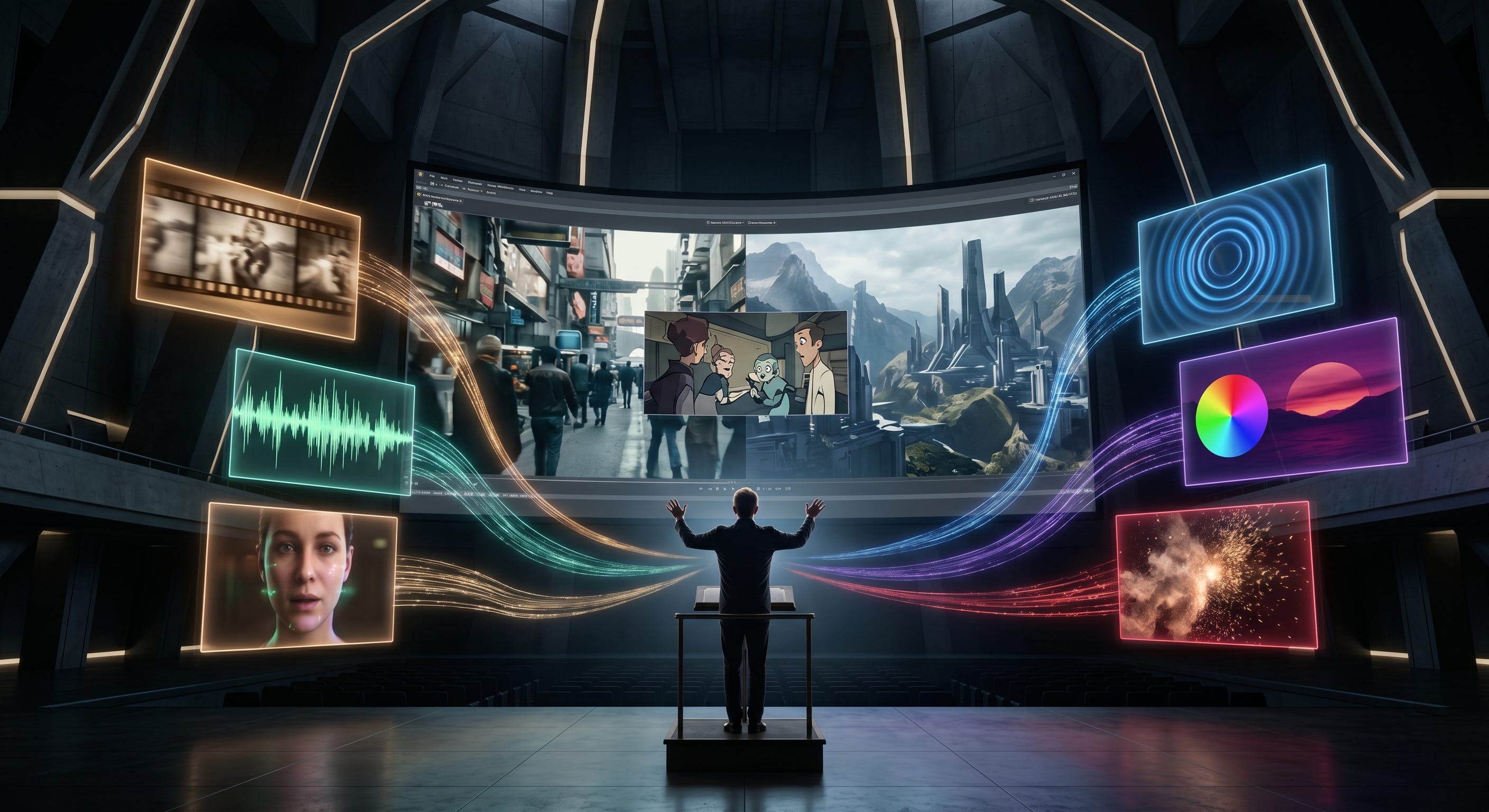
Steven Soderbergh just told the world he’s using AI to complete a John Lennon documentary and a Spanish-American War epic. Last week, the Academy announced that only roles “demonstrably performed by humans with their consent” are eligible for acting awards — and that screenplays must be “human-authored,” with the right to investigate any submission.
Two moves. One industry. Completely opposite directions.
And somehow, they’re both right.
The reflexive take is that this is a war — human creativity versus machine efficiency, authenticity versus speed, art versus slop. But that framing misses what’s actually happening. Hollywood is not fighting AI. It is drawing the legal perimeter of authorship. And the creators who understand that distinction are going to own the next decade.
The Academy’s rules are a design brief, not a death sentence.
What the Academy is actually saying is this: we don’t care how you make the film. We care whether enough human intent survives in the final work to make it legible as art, not output. Soderbergh himself admitted it: AI “desperately requires very close human supervision.” That is not a concession. That is the entire point.
The critics calling his John and Yoko documentary “Liverpudlian slop” are missing the ratio. Ninety percent of the film is archival stills. The AI-generated sequences (roughly ten minutes) exist specifically where no literal imagery could. That is a creative decision, not a surrender. The question is not whether AI is present. The question is who is directing it and why.
Prompting is not a button press. It is a discipline.
Soderbergh’s own description gives it away: “you need a Ph.D. in literature to tell it what to do.” That is not a complaint about the technology. It is an accurate description of what prompting actually demands — precision, cultural reference, tonal control, the ability to constrain a system that will otherwise drift into generic noise. In horror production, where I am currently working across multiple AI models simultaneously, that drift can often be a gift: the uncanny wrongness of a broken prompt can produce something no deliberate output ever could. However, in a historical epic, it is a liability. The hybrid creator knows the difference and adjusts accordingly.
This is what separates orchestration from automation. Automation replaces judgment. Orchestration requires it.
There are two kinds of orchestration, and you need both.
The first is creative: combining tools, models, and human editorial judgment into something none of them could produce alone. The director conducts; the machine plays. The output may involve AI, but the vision is irreducibly human.
The second is strategic: structuring the workflow so the final work retains enough demonstrable human authorship to be protected, credited, and monetized. This is not cosmetic. This is the difference between intellectual property and a floating digital artifact that belongs to no one and can be claimed by anyone.
The Academy’s rules are forcing this second kind of orchestration into the open. Creators who have been vague about their process — or who have leaned too heavily on generation and too lightly on direction — are being asked to account for themselves. That accountability is not a penalty. It is a standard. And standards, historically, separate professionals from amateurs.
The real threat is not AI. It’s passivity.
The backlash to Darren Aronofsky’s AI-generated series, the Late Night With The Devil controversy, the discomfort around The Brutalist‘s accent refinement — none of these failures came from using AI. They may rather have come from using it without sufficient craft, transparency, or human editorial authority. The audience is not opposed to the tool. It is opposed to the absence of a director.
Some critics have invoked Satoshi Kon’s Paprika as the definitive counterargument: hand-drawn surrealism built entirely from human imagination, proof that cinema has always had the tools to build dreamscapes without algorithmic assistance. It’s a fair point — and a beautiful film. But it mistakes the argument. Nobody is claiming AI dreams better than Kon did. The claim is narrower and more interesting: that a skilled director can deploy AI as a specific instrument within a larger human vision, precisely the way Kon himself used 3D CGI selectively inside an otherwise hand-drawn world. The question was never AI versus human. It was always who is conducting, and how well.
Raoul Peck used AI-generated images to illustrate misinformation in his Orwell documentary. Radu Jude used it satirically. Both cases worked because the human intent was legible. The AI served a vision. It did not replace one.
Soderbergh has always been a systems thinker — he has shot films on iPhones, compressed productions to skeleton crews, and built independent distribution models while others waited for studio greenlight. His AI experiments are consistent with that logic. The question is not whether he should use the tools. It is whether he can maintain directorial authority over them clearly enough that the work survives as his.
Authorship is not a wall. It is a skill.
In a world flooded with generated content, the scarce resource is not production. It is judgment. Taste. The ability to know what to keep, what to discard, and how to make the machine serve a larger intention without erasing the human fingerprint.
The Academy’s new rules, the industry’s defensive posture, the audience backlash — all of it is pointing toward the same conclusion. Pure automation produces output. Orchestration produces authorship. And authorship, in this industry, is the only thing that has ever been worth owning.
Not prompt. Orchestrate. Not generate. Direct. Not replace. Combine.
The future does not belong to the creators who reject the machine, or to the ones who surrender to it. It belongs to those who can move between both worlds without losing authorship in the transition.
That is the orchestrator's edge. And right now, most of the industry is still arguing about whether to claim it.
great article